Synonyms for Furthermore: 12+ Words With Examples
Most writers reach for “furthermore” the moment they need to add one more point — and then they reach for it again, and again, until every paragraph starts to sound the same. This guide fixes that. Below you’ll find real synonyms for furthermore grouped by register — formal, neutral, and conversational — each with a one-line definition and a natural example sentence, cross-checked against Merriam-Webster’s thesaurus entry for furthermore.
Quick Answer
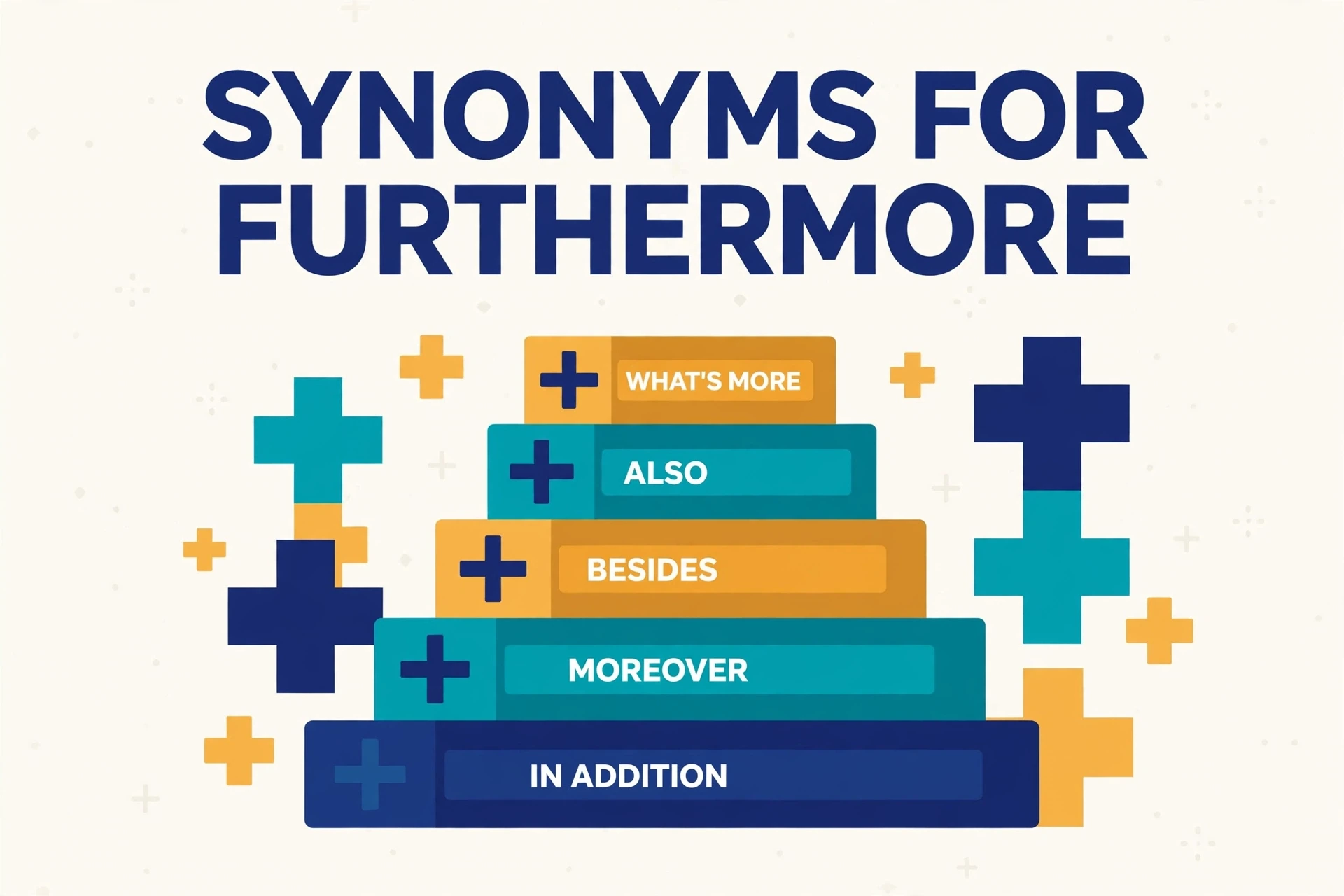
The 12 best synonyms for furthermore, each matched to the situation where it shines:
| Word | Nuance / When to use it |
|---|---|
| moreover | The classic formal add-on; strengthens an argument in essays, reports, and speeches |
| additionally | Neutral-formal; adds a separate, equally weighted point |
| further | Formal and concise; furthermore’s shorter twin in business writing |
| in addition | Formal phrase; introduces an extra item in a flowing, list-like sentence |
| also | The everyday default; works in almost any sentence |
| besides | Casual; adds a supporting point, usually in speech |
| as well | Neutral; tacks an extra on, often at the end of the sentence |
| too | Informal and short; adds agreement or one more detail |
| what’s more | Conversational and punchy; adds a point with extra energy |
| not to mention | Emphatic; highlights a point almost too obvious to state |
| on top of that | Casual idiom; stacks one more thing onto the pile |
| equally | Formal; adds a point of matching weight or importance |
Simple rule: match the register to the room — use moreover and additionally in essays and reports, also and as well in everyday writing, and what’s more or on top of that when you’re talking to friends.
Formal & Academic Synonyms for Furthermore
These are the options that belong in essays, research papers, formal emails, and professional reports — every one of them can open a sentence with a comma after it.
- moreover — Adds a point that strengthens the argument you’re building. Example: The policy is expensive; moreover, it has never been tested at this scale.
- additionally — Adds a separate, related fact without ranking it above or below the last one. Example: The library closes at six; additionally, it is shut on Sundays.
- further — A slightly shorter, equally formal connector common in business and academic writing. Example: The device is fast; further, it uses half the power of last year’s model.
- in addition — A formal two-word phrase for introducing one more item in a flowing sequence. Example: In addition, applicants must submit two professional references.
Neutral & Everyday Synonyms for Furthermore
These work in blogs, messages, and general writing without sounding stiff or slangy.
- also — The universal add-on; slots into nearly any sentence without changing its tone. Example: She speaks French; she also reads German fluently.
- besides — A casual way to add a supporting point, most common in speech. Example: We should drive; besides, the train is more expensive this week.
- as well — A neutral extra, usually parked at the end of the sentence. Example: I enjoy hiking, and I like cycling as well.
- too — Short and informal; adds agreement or one more small detail. Example: The room is spacious, and it gets great light too.
Conversational & Emphatic Synonyms for Furthermore
These add personality and punch — perfect when you want the extra point to land harder, but keep them out of formal papers.
- what’s more — Adds a point with energy, often something surprising. Example: The hotel is central; what’s more, breakfast is included.
- not to mention — Flags a point as obvious but worth saying out loud. Example: He’s a great programmer, not to mention a brilliant designer.
- on top of that — Stacks one more thing on the pile, often something annoying. Example: The flight was delayed; on top of that, my luggage went missing.
- equally — Adds a point presented as matching the last one in weight. Example: The plan is risky; equally, doing nothing carries its own risk.
Common Mistakes
Just as mixing up complement vs. compliment or accommodate vs. accomodate can confuse a reader, the wrong transition word can flip your sentence’s meaning entirely. Here are the four traps to avoid:
Mistake 1: Using “however” to add a point
❌ The hotel is cheap; however, it has a pool. (This makes the pool sound like a downside.)
✅ The hotel is cheap; moreover, it has a pool.
Why: “however” signals contrast, not addition — it undercuts the point instead of supporting it.
Mistake 2: Using “therefore” for simple addition
❌ She enjoys hiking; therefore, she enjoys camping. (This claims camping follows from hiking.)
✅ She enjoys hiking; she also enjoys camping.
Why: “therefore” means “as a result” — use it only when the second point is caused by the first.
Mistake 3: Using “then” for logical addition
❌ The plan is cheap, then it is fast.
✅ The plan is cheap; additionally, it is fast.
Why: “then” sequences events in time, so it sounds wrong when you’re stacking qualities of the same thing.
Mistake 4: Stacking two add-ons in one sentence
❌ Furthermore, moreover, the cost is far too high.
✅ Moreover, the cost is far too high.
Why: two connectors doing the same job is pure redundancy — pick the strongest one and delete the other.

How to Choose the Right Synonym
- Match the register first. Academic or professional document? Stick with moreover, additionally, further, or in addition. Texting a friend? Also, besides, and on top of that fit.
- Decide how much punch you want. What’s more and not to mention add energy and emphasis; also and as well add quietly without fanfare.
- Watch your sentence position. Moreover, additionally, and in addition naturally open a sentence; also and too slide into the middle or end; as well almost always closes the sentence.
- Formal vs. casual is a spectrum, not a switch. Furthermore itself is formal; if your document already uses contractions and “I”, also or besides will match better than moreover.
- Beware the afterthought trap. “Besides” can make a point sound like an afterthought, and “on top of that” can sound like complaining — check the attitude each one carries.
- Vary, don’t repeat. Using three different connectors across a paragraph reads far better than repeating “furthermore” three times; keep two or three favorites in rotation.
Frequently Asked Questions
What is a synonym for Furthermore?
Moreover is the closest one-word synonym — same meaning, same formal register, and it opens sentences in exactly the same way.
Is “furthermore” too formal for everyday emails?
For quick work emails it can sound stiff; “also” or “as well” read warmer. In formal reports and proposals, furthermore is perfectly at home.
What is the difference between “furthermore” and “moreover”?
Very little — they are nearly interchangeable. “Moreover” can sound slightly more forceful when you’re building an argument point by point, while “furthermore” feels a touch more neutral.
Can “furthermore” start a sentence?
Yes. Place it at the start of the sentence and follow it with a comma: “Furthermore, the results were confirmed by a second study.”
Which synonym works best in academic writing?
“Moreover”, “additionally”, “further”, and “in addition” are the safest choices — all four are standard in published academic prose.
Conclusion
From the formal weight of moreover to the casual punch of what’s more, the right synonym for furthermore depends on your audience and your tone. Keep a few from each register in rotation, watch out for contrast words masquerading as add-ons, and your writing will never sound repetitive again.